Friend person- "Hey Julie, how have you been? What've you been up to?"
Me- "Dude. Space balloons."
All I can think about these days is space balloons. You want to hang out? I better check I'm not doing space balloon stuff.
I'm getting a massage? Note to self...don't forget to email Cherry Point back about the hypobaric chamber.
We're at the grocery store? Got to get some clearance, vegan, Space Cookies.
But what is this?!!? What the heck is a space balloon?
Back in August I swore that this year I was going to do some heavy duty laurel resting at work and just cruise through. I've had some really hectic...years...at work for the last....ever...and it seemed like a good idea to just stop volunteering for extra stuff and see what life is like for a normal college instructor.
And then my boss was like, "Hey. We have an opportunity for a grant where someone will lead a bunch of students so they can launch something into spa...." and I'd torn the application from her hand and filled it out before she could say, "...ace."
My whole life I've been enamored with NASA. My parents were the type of parents to take us to Space Centers to see all the launch pads. I saw Apollo 13 in the theater on vacation. We went to the 3D IMAX space movies and I remember exactly were I was when the Challenger exploded.
I've read a ton of books about astronauts, astronaut wives and thwarted female astronauts.
I had one of the biggest honors of my life when I had the opportunity to work with Stennis Space Center as part of the Mississippi Space Commerce Initiative.
Some people love space exploration for the things we learn about the solar system, the Moon or other planets. I love it for what we learn about the Earth! This is why I've always been drawn to satellite cartography (photogrammetry and remote sensing) and GPS.
So what is this space balloon project?
We're part of a challenge given to a handful of North Carolina community colleges to launch a weather balloon into near space. As part of this grant we've been given a $20,000 budget and a packet of non-negotiable requirements.
For starters, our balloon must be carrying a required payload of materials. Many hobbyists and school kids have launched balloons like ours. (Apparently it's a thing! Yes, I know Duke has done it. I don't care!) It's a big challenge on its own but ours is a challenge wrapped in a challenge with a creamy marshmallow center that is going to expand and then violently contract.
Our entire thing, warts and all, can only weigh 2.5 kg.
It can't have any (planned) ejectables or pyrotechnics. All of the parachute and balloon lines must be less than 50 lb test. The thing needs to fall between 15-25 feet per second. (Ugh. Math.) But we're also competing for highest flight, best photo and best scientific experiment.
At minimum on board we need to have an:
- Arduino Uno - this is a tiny "computer" that can have sensors wired to it.
- Triple Axis Accelerometer- this records speed and directional data, it's triple axis because it does x,y coordinates but also elevation change.
- Barometric, UV index and temperature sensors
- A hacked Canon Powershot
- A Big Red Bee Beeline radio tracker, 70 cm @ 100 mW and Beeline GPS tracker, 2 meter- These are finicky GPS doodads.
All of the above business might seem easy-peasy at first blush. Get all of those weird thingies, cram them into a tiny box and send them to space. SO SIMPLE! HOW IS THIS EVEN FUN?
But man, oh man, you are the wrongest about that. I was once in your shoes, I know how you feel, but I also know how I feel now and that is T-I-R-E-D. Each one of those innocent looking bullet points is its own special little Pandora's box of thwart.
That tiny computer? It needs to be programmed, soldered and you're going to need to be some sort of technical whiz to make it go. The sensors? Each one needs its own set of code or else it's just the tiniest paperweight you've ever seen. (Very ineffective.) The Canon needs to not only be hacked to take photos by itself, it needs to be placed very carefully in the hull so you don't accidentally fling $500 into the ether or take pictures of the inside of a styrofoam cooler for two hours. It needs to be able to survive space, a vacuum, very high temperatures, very low temperatures, static, being sling-shotted around during burst and possibly a water landing. So make sure to pick the right one of any of the 7 million Canons available.

The Big Red Bee GPS? If you can figure out how to work it (insurmountable) then you have to figure out how to USE it and that's gonna require that you get a HAM Radio license (Read a book. Take a test!), learn how to use the radios and then you have to choose the right antenna....and THEN you have to put that thing together. (Spoiler alert: It has 200 pieces! Most of which are little rods with minutely different lengths. They are not labeled. ENJOY! PS you forgot to buy an eensy booger that makes the thing go.)
What is the tether made out of? How do you inflate the balloon? Which chute do you want? What's your chute ring made out of? Heck, what is all of this stuff going to be sitting in that is going to be light enough to meet your goals but sturdy enough to go to SPACE????

It's not rocket science. Rocket science has more credible literature and is easier to research. This you make up as you go along.
We're also adding a GoPro and a radiation sensor experiment. (And vegan space cookies.)
And alllllll this stuff? It all requires batteries. And those batteries need to be space batteries.....and space batteries are heavy AND ALL THE SUDDEN 2.5 KG SEEMS LIKE CRAZY TALK AND YOU'RE WALKING AROUND HOME DEPOT PICKING UP TINY PLASTIC WASHERS AND THINKING, "I DON'T KNOW. THIS SEEMS HEAVY."
*Hyperventilates*
So yeah, it's all a bit more challenging than it sounds. On top of just getting this all up and running we have to:
Manage the amazing budget
Complete a Critical Design Review presentation
Have two site visits (for us they were conference calls)
Complete a Launch Readiness Review
Compile a project manual and create a scientific poster
File a report after the fact
But I'm not worried...I am busy...but I am not worried...because I have the most incredible team that Chance and Fate (Yes. Proper nouns.) could have possibly brought together.
I would not have even considered this project if I hadn't been accidentally introduced to this guy about a year ago:
He is the Student Team Lead for the project and he is our, "Houston." No one at DTCC knows more about space stuff. He runs our meetings (9pm Wednesdays and at least two hours every Sunday) and sends out meticulous minutes. He schedules, orders, budgets, intimidates, plans, wrangles, nerd-herds and occasionally coerces.
With all of those sensors and software that needs to be written you're going to need someone who knows how to program. How about a programming genius? This guy programs apps for fun when he's bored.
I am totally blown away by his dedication to the project and the miracles he's been able to perform. But you can see he has a lot of wires on that breadboard and for that you're going to need someone who knows about electronics.
Bonus points if that person can weld, solder and roll their eyes at you because it's all SO easy to him.
If you're going through all the trouble of wiring and programming all of the required sensors, and the team doing it is making it seem like (eating) a piece of (space) cake....then you should probably send some science stuff to space besides space cookies.
So wouldn't it be marvelous if you had a competent, highly organized and motivated future environmental scientist on the team? Possibly one who could handle that poster and binder in her sleep?
And/or someone to hack the bloody Canon and wrestle two GoPros so we can have some sort of non-cellphone based evidence that we did all of this work?
OK, so this balloon goes up-up-up into the sky and then it reaches a certain height and bursts. Then it spazzes out and spins for a while before it straightens out into a nice plummet. Eventually it hits enough atmosphere to engage the parachute and gently, softly, carefully glides to where you've been waiting for it for the last few hours.
Right?
No.
Wrong.
Super wrong.
Perhaps, the wrongest.
The thing is going to drift around....perhaps for miles....perhaps to other cities....perhaps into the OCEAN....so if you have any hope of recovering your precious electronic cargo you'd better have a GPS expert.
OK, if you don't have a GPS expert, or if you have one who isn't allowed to help too much, you should at least get someone clever who is eager to learn and has a good sense of humor about it.
And when you find your needle in a haystack in a stack of haystacks, it's all going to be smashed to smithereens (if you even managed to get it off the ground in the first place) if you don't have a solid hull. For that you're going to need an engineer.
And we have the best engineer so you're out of luck
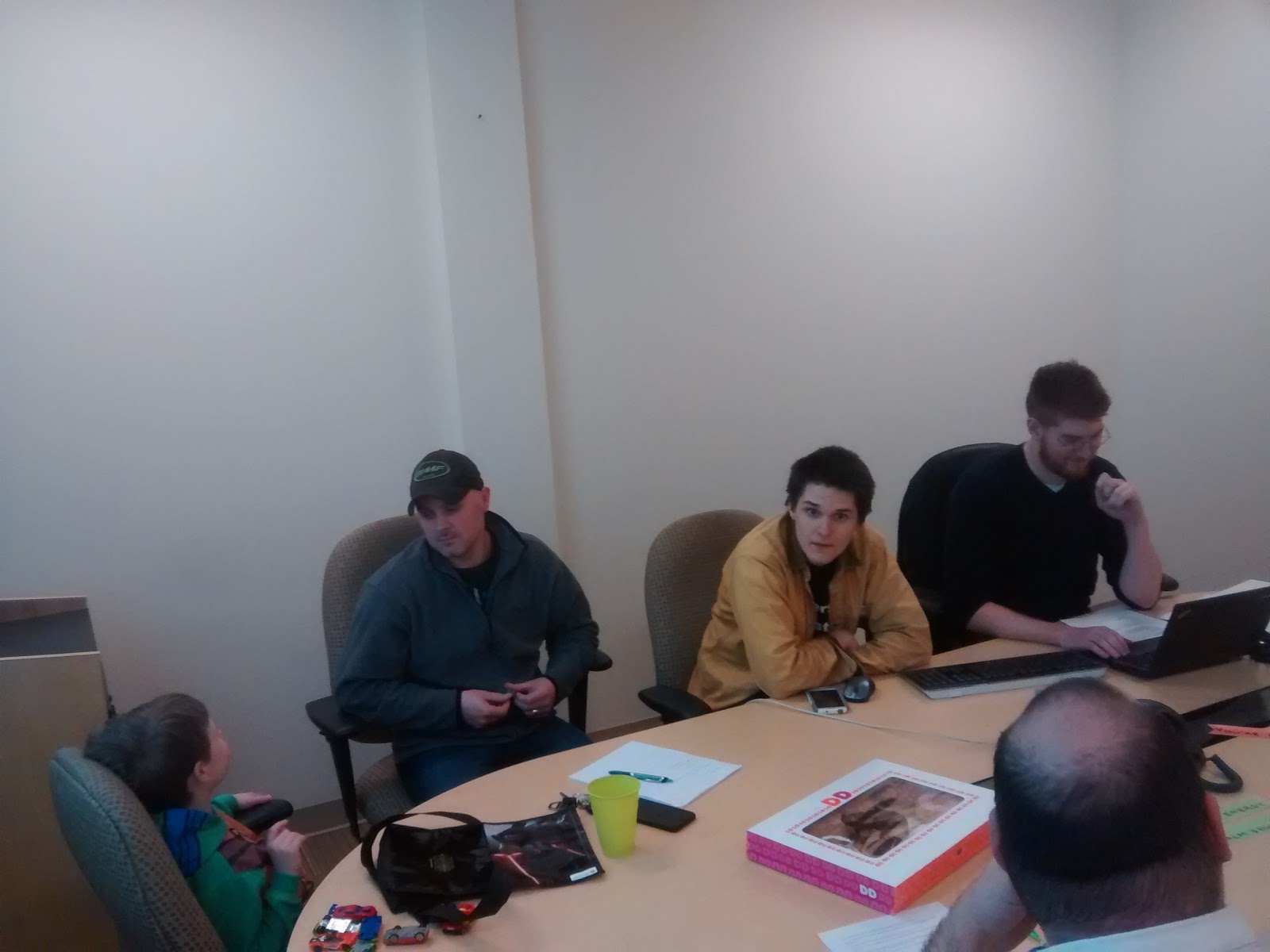
Seriously though, I am in awe at my team that I have accidentally assembled. With this much talent....the only thing you need is someone to bring snacks to the meeting...and that's all I do.
As you can see this project is bigger, better and badder than it sounds. Ghana just started their own space agency and they are doing the exact same work we are doing! Working on this project has been such an incredible opportunity and I can't believe how much I've learned about space and engineering already.
We have now completed the design and build phase and we're finally starting the fun testing phase. (Time to try our best to torture and destroy everything we've been working on since September on purpose!)
Our Launch Readiness Review is in a few weeks, and our launch is in early April from Catawba Valley Community College.
Wish us luck!