
Saturday, April 7, 2018


Thursday, April 5, 2018

Wednesday, March 28, 2018
She ain't purdy but she's sturdy.
That's a terrible rhyme and I apologize.
Spencer, our machinist, has finished the payload frame and she's a tank!


He's pretty proud of it.


We were concerned that March would be a stagnant month for production because of other obligations but we actually had a very productive month. Dan and Jimmy vacuum tested a lot of our new cameras and servos and we're happy to report that everything works!


He's pretty proud of it.

After a discombobulated month of ballooning, rovers, videos, visitors, weddings, and general chaos we finally all got back together

We were concerned that March would be a stagnant month for production because of other obligations but we actually had a very productive month. Dan and Jimmy vacuum tested a lot of our new cameras and servos and we're happy to report that everything works!

Murr was not pleased that her camera wasn't talking to the computer the way it's supposed to.

But then she got it to work!!!


Landon and Memes are doing robotic kinematics the old fashioned way. (Good luck to Landon on his upcoming FRR.)


And we have the (final?) revision to our robotic arm and Spencer will start machining it next week!

In the month ahead we have a HAB launch and a week at Kennedy Space Center.
Thursday, March 22, 2018
HAB 2018
Wednesday, March 21, 2018
Swarmathon Code is in!

Two weeks ago we had some decent code. Last week it turned into promising code. This week we have something worthy of the competition.
Testing was challenging again this year. The team worked within the bounds of the time we were allowed to be on campus. Obstacle avoidance takes on a new meaning when you have high winds, snow, and a severe lack of power cords in your testing arena.
Man's not hot (never hot) but he was pretty chilly on the last day of testing. Nothing like some late March snow/sleet to get the blood pumping for Swarmathon!


The team was caught unaware by a sudden cold snap and had to wear all of the coats I had been hoarding in my office.

Our final code was submitted at 11:58 pm.

Now all we have left is the video, technical report, and outreach report!
Yee! Yee!
Skkkkrrrrrrt. Pop! Pop! Pop! Pop! Pop!
Friday, March 16, 2018


Thursday, February 22, 2018
Space: the Vinyl Frontier
We spent a small amount of our hard-earned 'extra' money (read: from chopping Dan's hair off) on a photo backdrop that we can use as a stage piece for our outreach, as a super-authentic vignette for our team pictures, and as a general morale booster in these weeks of frustrating testing:

(Viewers should not be alarmed by the lack of EVA suits on our team; Julie has been properly trained and equipped, and is safe from both depressurization, hypoxia, and cosmic rays.)
SUBLIMINAL MESSAGE: EVERYONE COME TO OUR FUNDRAISER THIS SATURDAY 24 FEB. ALL YOU HAVE TO DO IS BUY BEER AND THEN DRINK IT.
We isolated the issue with our first servo test (we're convinced that we were just asking too much, mechanically, of our servos) and have Ol' Foamy ticking happily along, as you can see in the video below:

(Viewers should not be alarmed by the lack of EVA suits on our team; Julie has been properly trained and equipped, and is safe from both depressurization, hypoxia, and cosmic rays.)
SUBLIMINAL MESSAGE: EVERYONE COME TO OUR FUNDRAISER THIS SATURDAY 24 FEB. ALL YOU HAVE TO DO IS BUY BEER AND THEN DRINK IT.
We isolated the issue with our first servo test (we're convinced that we were just asking too much, mechanically, of our servos) and have Ol' Foamy ticking happily along, as you can see in the video below:
Wednesday, February 21, 2018

Saturday, February 10, 2018
Resting Our Eyes
Generally speaking, testing days are some of the least fun and most necessary parts of the work. It's never as quick as one hopes, often fraught with nested, independent hurdles, and any progress we do make seems vastly disproportionate, in the bad way, relative to the effort required.
Ol' Foamy's job is to hold everything in place while we test two of our servos. We installed a wooden arm on each, to which weights can be attached so we can get a baseline idea of how they perform in vacuum while under load. Note the successive layers of tape; this is rapid prototyping at its finest. Handsome Dan did a great job whipping together the original test stand in an hour, and we've been improving on it every test day.
Keeping in mind that this is essential to the project's success is sometimes difficult. We occasionally take breaks, though, to shore up morale. Today we rested our eyes a bit; we've been selecting googley eyes that are right for "Ol' Foamy", our test stand, so that its constant shaking and gyrations will be more amusing. (I forgot to take pictures of the end result, but will post them later.)
Here are a couple photos from today's break. I decided not to try it as a selfie for reasons that may be apparent:


 |
| Ol' Foamy (sans eyes). Also n.b. the egregious amounts of caffeine and junk food that fuel serial Saturday workdays. |
 |
| Documentation! is! important! |
Here are a couple photos from today's break. I decided not to try it as a selfie for reasons that may be apparent:


Friday, February 9, 2018

Wednesday, February 7, 2018
Disco Beckies Pass Their PDR
Yesterday was a big day for the Disco Beckies because they had their first PDR for the HAB project.

They'd been working on getting things up and running and feeling pretty good about their prototyping and design, but still, the PDR is always the true test.

Things were pretty tense during the teleconference but Dan, Seth, Kevin and Oliver did a great job when it was their turn to speak.

The judge liked our designs and offered some feedback to help us improve our power management and water resistance.

Everyone was giddy with excitement when it was over and Seth and Oliver took the opportunity to give an impromptu hull bongo performance.

Oliver got his shirt in the mail! It's incredible!


Monday, February 5, 2018
NASA Spotlight: Interview with Peter Sooy

Images courtesy of NASA Satellite Servicing Projects Division
Last Tuesday, Julie, Jimmy, Dan D., and I attended a meeting at Goddard where members of the Satellite Servicing Projects Division met with industry partners to discuss private sector uses for their technology. There's not a whole lot we can tell you about what we learned, but I can say that yet again everyone at NASA was wonderful, welcoming, and incredibly helpful and that we gathered some information that will be useful as we start testing our robot arm and refining the design. We even got to have lunch with Zakiya, who gave us the tour of SSPD in December, and peppered her with questions about interning and why not to use certain types of grippers on our arm.
During our time there, I was able to sit down with Peter Sooy, the Education and Public Outreach Coordinator for SSPD. He was generous enough to let me interview him about life at NASA and to provide some advice for people who want to join the agency.
 What is your position
with NASA and what does it entail?
What is your position
with NASA and what does it entail?
My official title is Education and Public Outreach Lead for
the Satellite Servicing Projects Division. So what does that entail?
Interacting with student groups, so that’s the education part. I give tours to
students of all levels of our robotics operation center. I just counted up- in
2017, we had 239 tours that we gave to 3,002 people. And I don’t know how many
I gave, but I probably gave 50 in a year and all the other ones I coordinate. I
do all the scheduling and coordinating tour leaders, so that’s the education
part.
The public outreach part is going to events and running a
booth or exhibitions. We go to, like, three to six events a year. They're either
local, like in DC, or national. We’ve been to SXSW, we’ve traveled to other
places. We run a booth and I coordinate the volunteers then ship everything out
and run the booth. It’s a way to promote our office, to promote satellite
servicing, and if along the way we meet a young engineer and they say, “You
know, I love this and I love you guys!” we always say, “Yes, please!” I give
out my card and if they're willing to travel to DC we try to accommodate student
groups as much as we can.
What is your
educational background?
I have a Bachelor’s degree in Journalism from University of
Maryland just down the road. I graduated in 2009.
What are your
favorite parts of your job?
I’d have to say the pace of it, being able to be at an event
like this today where I can talk to a bunch of professionals from industry and
then the next day give a tour to a bunch of 8-year-olds. It’s just having a lot of different things to
do and its exciting, fast paced, and different. It’s not the same task everyday
so it doesn’t get boring.
What are some perks
of working at NASA that we might not know about?
There are perks! In addition to going to events, which are
very cool, sometimes you get to see exhibits or famous people. Going to
launches, I’ve only been to one, but it was really cool. That was a really cool
perk. Last year we had a project go up to space station that launched from
Kennedy. It was a SpaceX launch from Pad 39A, which is where Buzz Aldrin went
to the moon. They brought him to the launch and I got to meet him which was an
additional perk. When I started working here, I never thought I’d get to meet
Buzz Aldrin, so that’s an easy perk to pick out.
What are some
challenges you face at work?
Staying focused and keeping a broad vision, not getting
tunnel vision on one event for one day and keeping everything moving with a lot
of different tasks going on at once. Sometimes that can be problematic for me,
where I focus on one task and then something that I’m not focusing on can have the
ball dropped. So staying on track and organized and aware.
What surprised you
most about working at NASA?
I don’t know about for all of NASA, but definitely for this
division it’s the people. I expected, even as a kid, the people at NASA would
be smart, but I’ve worked in other industries with smart people but they
haven’t been nice to work with, they were difficult and mean and rude. The
people here are very nice. So in addition to being highly intelligent they’re
nice to work with and I’ve really run into few people that are hard to work
with which is rare.
What is the most
expensive thing you’ve touched?
Um…to be honest they don’t let me touch a lot of things, I’m
not an engineer. But we have some expensive stuff in our robotics facility that
needs to be covered up to be photo safe, so nothing sensitive is showing. The
other week I did go in and cover up out robotic arm, our cutting-edge robotic
arm, under supervision of our engineer. I wore my little gown and wrist strap
and I covered it with safety bags. I didn’t get to touch it, but it does cost
upwards of $5 million so…that was expensive!
What is your favorite
thing in the cafeteria?
Not very exciting but the Subway. The Italian BMT is my
favorite thing.
What advice do you
have for students that want to join NASA?
I get asked that a lot, so I always tell kids to pursue what
you enjoy. If that’s engineering, that’s great. Truthfully, most people who
work at NASA are engineers. But if it’s your dream to work here and you’re not
an engineer, just keep trying. This is a big agency there’s almost 100,000
people at all of NASA so to keep all that working you need more than engineers,
you need business people, you need communications people, you need human
resources people. I always tell people to keep trying, to not give up on their
dreams. If you really want to work here, you can in some capacity. So you may
not be the one touching the hardware but you might be the one helping write the
contract for publicizing the hardware. It takes a village to make this all
work.
Which NASA center is
the best?
Oh man! I think Goddard is. For work-life balance, I’d say
Goddard is. I’m an East Coast person, I’m local to the area so I like being
near D.C. but being out here with all the green space is kind of like Mayberry,
very nice.
If you’re going for mission and all that …I’ve been down to
Kennedy and I did like Kennedy. It’s in the middle of nowhere in Florida. For a
day trip? I’d say Kennedy, that was nice. I’ve been to JPL, LA is hard to beat
but I like Goddard.
Thanks, Peter, for letting me pick your brain and thanks SSPD for having us. We hope to see you again soon!
Sunday, January 28, 2018
We're in!
Without further fanfare, we've been fully accepted to the HASP 2018 flight.
This is exciting for many reasons:

This is particularly validating, as we have always striven for excellence in our technical writing. We put a lot of time into our paperwork, since we believe that strong communication is particularly essential in the world of grant-funded, public-outreach-oriented science. Our HAB team was awarded "Best Documentation," something we're still proud about years later. Making our way onto HASP's website as an example has been our ambition from the get-go. (We'll see if we actually get there, but even being recommended for it is high honor.)

Thanks to all the reviewers and administrators of the HASP program: y'all do a lot of work for us students, and we deeply appreciate it. Project-based learning like this is excellent experience for life.
Those of you watching from home may recall our earlier post about what our project actually is: we're flying a robot arm of our own design & manufacture.
During flight, the arm will be autonomously running through repeated dexterity exercises, using its own on-board camera 'eyes' and computer 'brain' to flick switches, press buttons, turn knobs, and grasp and move blocks.
We'll be measuring its performance to see how well it holds up over the entire flight, since [near-]space is a harsh, harsh place even for handsome robots:
This is exciting for many reasons:
- we were competing for one of the coveted 4 large payloads (HASP features 12 total seats, 4 large and 8 small)
- we're going back to space (and, by extension, NASA facilities in New Mexico, Texas, Maryland, and Virginia)
- our payload proposition is much more ambitious this year, and much closer to state-of-the-art than our tamer atmospheric experiment, GOAT
- WE WERE FULLY ACCEPTED on the first try with ZERO NEED FOR REVISIONS. For contrast, our proposal for GOAT came back with 4 pages of comments and to-dos, which turned into a solid month of work.
- Not only do we have ZERO REVISIONS, the comments were utterly glowing:
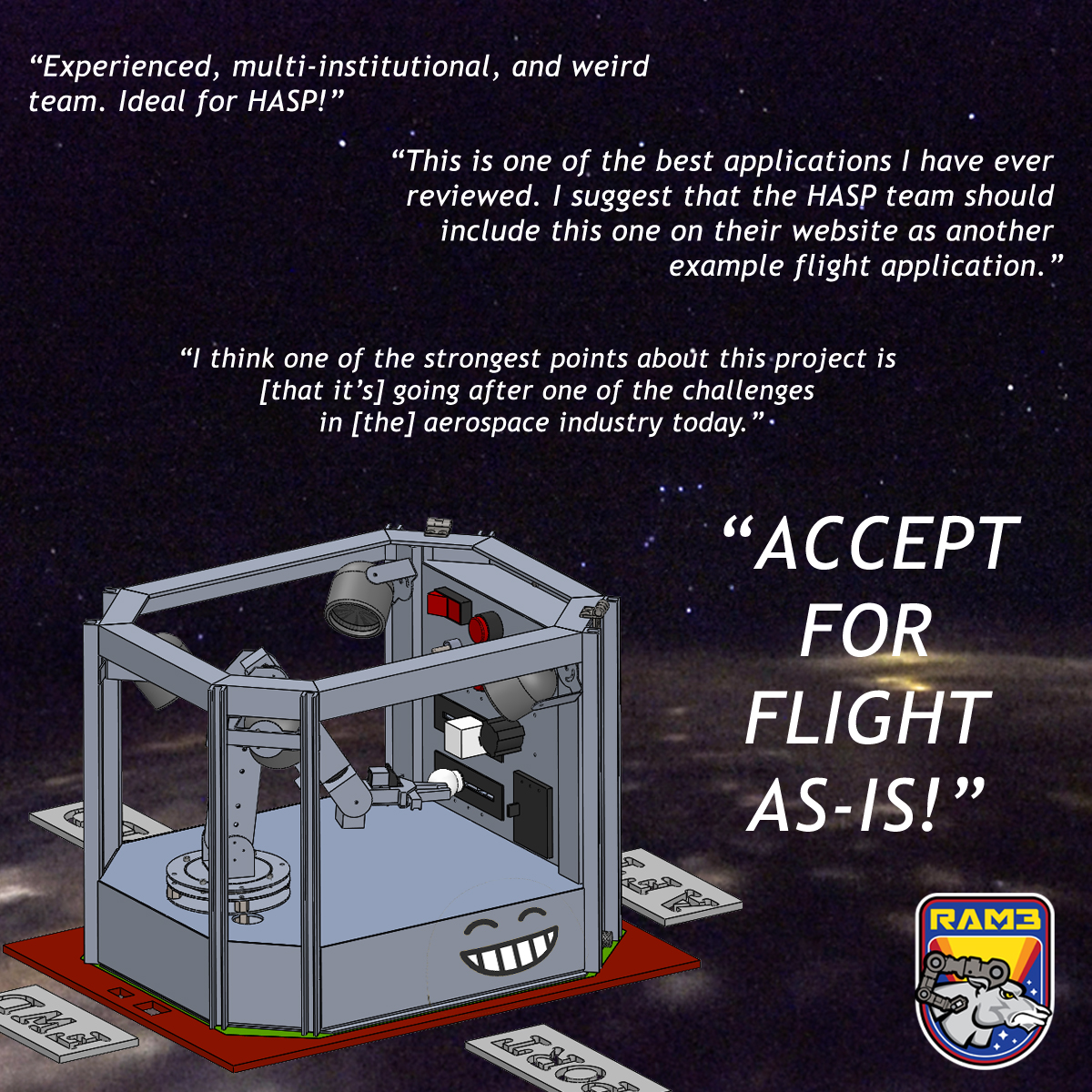
This is particularly validating, as we have always striven for excellence in our technical writing. We put a lot of time into our paperwork, since we believe that strong communication is particularly essential in the world of grant-funded, public-outreach-oriented science. Our HAB team was awarded "Best Documentation," something we're still proud about years later. Making our way onto HASP's website as an example has been our ambition from the get-go. (We'll see if we actually get there, but even being recommended for it is high honor.)
Thanks to all the reviewers and administrators of the HASP program: y'all do a lot of work for us students, and we deeply appreciate it. Project-based learning like this is excellent experience for life.
Those of you watching from home may recall our earlier post about what our project actually is: we're flying a robot arm of our own design & manufacture.
During flight, the arm will be autonomously running through repeated dexterity exercises, using its own on-board camera 'eyes' and computer 'brain' to flick switches, press buttons, turn knobs, and grasp and move blocks.
We'll be measuring its performance to see how well it holds up over the entire flight, since [near-]space is a harsh, harsh place even for handsome robots:
- heat can build up, especially with the sun hitting us full-blast,
- electronics might misbehave, and
- our semi-liquid lubricants will exposed to an environment that really doesn't encourage anything staying as a liquid. As anyone who's read or seen The Wizard of Oz can attest, machines with moving parts really don't work well without lubricants.
Now we've got to go actually try and build this thing. We're only a month or so behind, so stay tuned for some high-quality panicked flailing.
Tuesday, January 16, 2018
Spotlight on HAB

One of the other science teams at Durham Tech is working on a project called High-Altitude Ballooning, or HAB. These crazy kids are hard at work right now on their Preliminary Design Review. The team is lead by Dan K., also of the Unacceptable Risks and Durham Programmabulls. Spencer is the mechanical engineer, Oliver the camera guy, Ruthie is tackling documentation, Chris is the parachute guy, Citlalli and Kevin are the wind trackers, and Destiny the social media rounds out the bunch. Stay tuned for more news from the HAB team as they tackle this project!
Monday, January 15, 2018
Nerd Paparazzi
I decided to take a break from badgering everyone with constant queries of "Hey, are you doing anything cool today? No? Why not? Do something cool." So I used my time incredibly wisely to roundup my favorite shots from our journey so far.

A man of eternal calm and serenity. I give you....Zen-cer.

This is pretty much how I see Dan in my head at all times.

Noah thinks he can escape my camera by sitting in the far corner of the lab, but he can't! And so far he's the one doing the most visually interesting work. (Take that, Noah!)
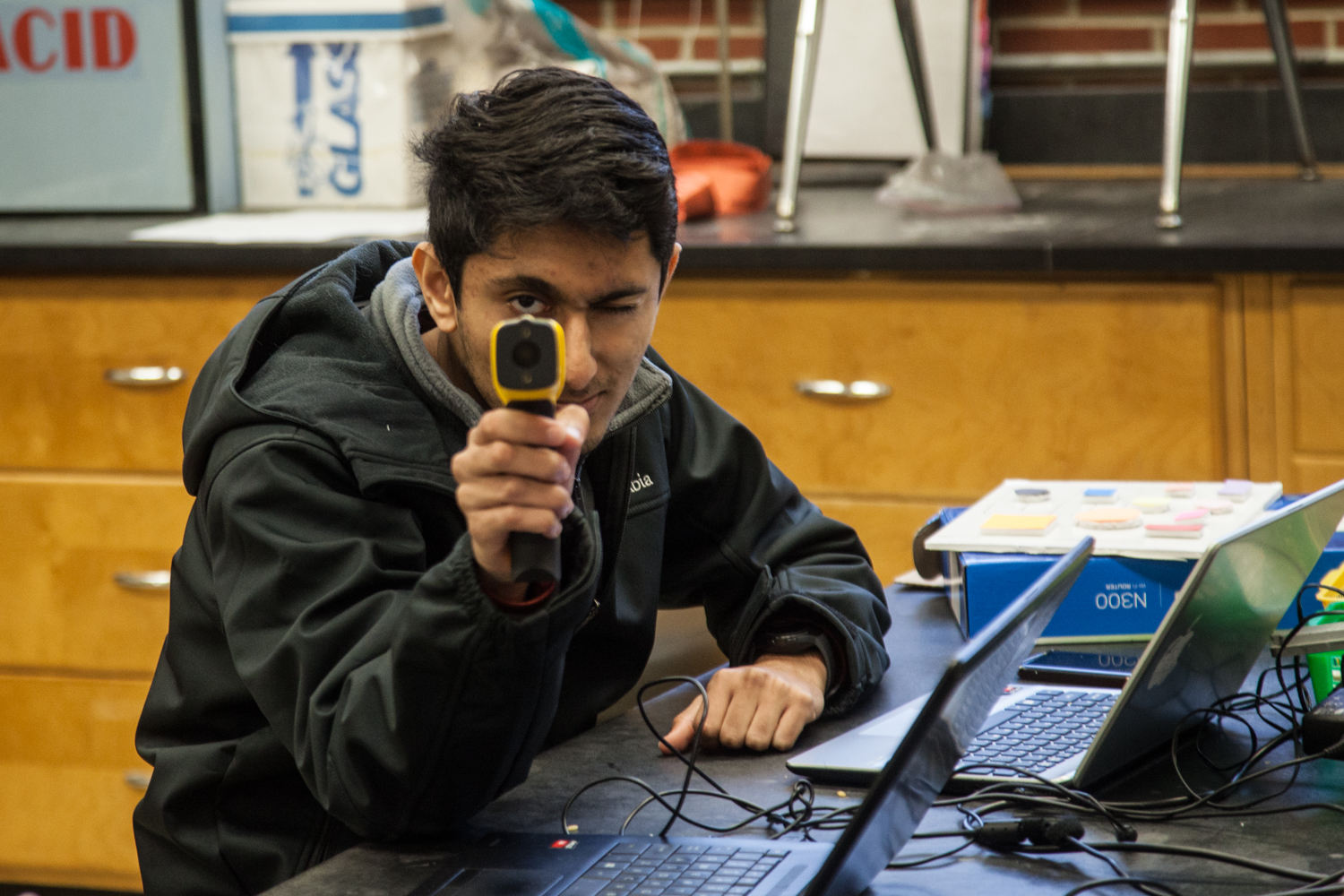
Soham, International Man of Mystery. Actually, it was FREEZING in DSBF and Soham was periodically checking the temp to confirm that yes, we were all in danger of becoming hypothermic.

I like to call this one "The HASP Supper". I think it belongs on r/accidentalrenaissance.
Subscribe to:
Posts (Atom)